Summer algae blooms can push wastewater lagoon effluent toward non-compliance by increasing total suspended solids (TSS) and, in some cases, five-day biochemical oxygen demand (BOD₅). Algal cells carried out with the effluent become part of the solids load, so even a lagoon that is otherwise treating wastewater effectively can face seasonal water quality problems.
To manage this, operators need to be able to:
- Spot the conditions that favor a bloom early,
- Understand whether algae is driving rising TSS,
- And choose a control approach before summer conditions peak.
This article looks at why summer blooms intensify in sewage treatment lagoons, how to diagnose the problem, and which control options can help.
Why summer pushes lagoons toward an effluent breach
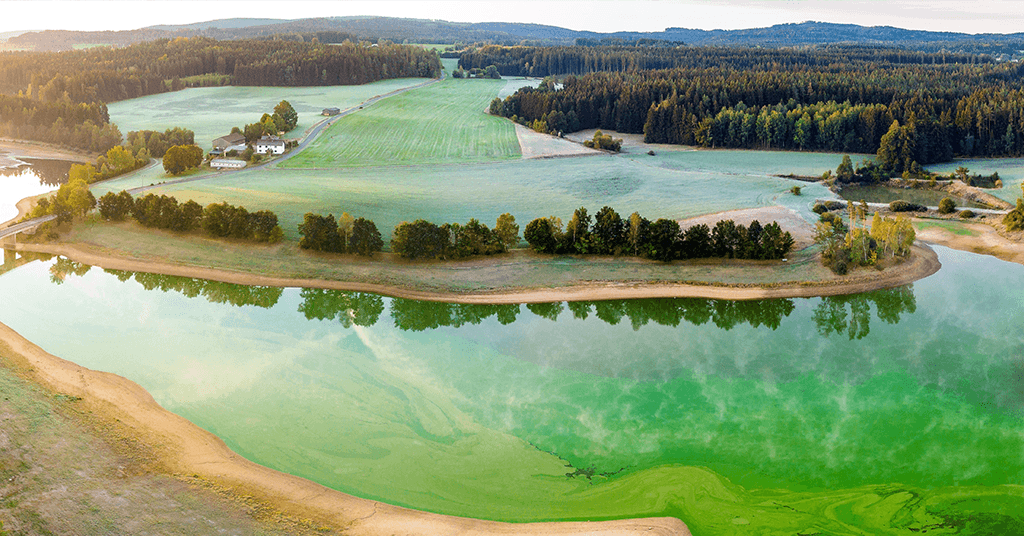
Algae are a normal part of many lagoon wastewater treatment systems, but summer creates several conditions that can accelerate algae growth at the same time. Summer algae problems are especially relevant in facultative and aerated systems; anaerobic lagoons operate under different biological conditions and are not managed around algal growth in the same way.
The main summer triggers
- Warmer water speeds up biological activity like rapid algal growth, including filamentous algae, especially where circulation is limited.
- More sunlight for photosynthesis gives algae more opportunity to grow.
- Nitrogen and phosphorus in wastewater provide the nutrients algae need to multiply.
- Stratification and poor circulation leads to uneven temperature and oxygen conditions, especially where mixing is limited.
- Low-oxygen zones can favor anaerobic bacteria, while areas with more dissolved oxygen support aerobic bacteria that help break down organic matter.
These factors can compound over the course of the season. As algal biomass increases, more cells can leave the lagoon with the treated water and contribute directly to effluent TSS.
Excessive algal carryover can affect both TSS and measured BOD₅, creating a compliance risk even when the underlying biological treatment process is still functioning. The key is identifying that trend early, before a seasonal bloom becomes an effluent-quality problem.
Catching a bloom before it breaches: algae can drive up lagoon TSS
In an algae-rich lagoon, a significant share of the suspended solids leaving the system may come from algal biomass. In some cases, effluent TSS can even be higher than influent TSS. In effect, the lagoon is manufacturing its own solids problem.
That does not necessarily mean the underlying biological treatment process is failing. It may mean algae are adding a new solids load as they grow and leave with the effluent.
Algae can become a suspended-solids problem
As a bloom develops, more algal cells remain suspended in the water column and can pass out with the final effluent. This can push TSS upward and, because algal biomass can also influence measured BOD₅, affect more than one compliance parameter at the same time.
The key is to work out whether the solids are mainly biological carryover from algae or a sign of another treatment problem.
A simple TSS-to-BOD₅ screening check
One useful screening rule looks at TSS alongside BOD₅. An effluent TSS of around 30 mg/L with a BOD₅ of 15 mg/L or less can point toward algae or sludge as the main source of the solids rather than poor organic treatment.
It should not be treated as a diagnosis on its own, but it can give operators an early clue that rising TSS may be bloom-related.
Where more certainty is needed, further checks such as microscopic examination or volatile suspended solids testing can help confirm what is actually making up the effluent solids.
Algae control options: filtration, chemical controls, aeration and circulation
Once algae begin to affect effluent quality, operators have several ways to respond. The right option depends on whether the goal is to remove algae that are already leaving the lagoon, change the conditions that favor growth, or both.
Reactive measures: Filtration and chemical controls
Filtration can provide a polishing step when algae are already contributing to high TSS. Sand and gravel-based filters can remove suspended algal biomass before discharge.
A 2026 analysis of more than 1,400 U.S. wastewater lagoons found that systems using continuous-feed sand filters and aerated gravel filters had geometric-mean effluent TSS concentrations 73% and 77% lower, respectively, than facultative lagoon systems. Those figures show the potential value of filtration, but they should not be read as a guaranteed removal rate for every lagoon.
Chemical controls may also be used to manage algae, depending on the site and local regulatory requirements. Their main limitation is that they can create an ongoing dosing requirement and may address the immediate bloom without changing the lagoon conditions that allowed it to develop.
Preventive measures: Aeration and circulation
Aeration and mixing take a different approach. By improving circulation, reducing stagnant zones and evening out temperature differences, they can make conditions less favorable for excessive algal growth.
EPA guidance for aerated lagoons notes that increased mixing can help discourage algae growth and improve effluent TSS. This makes aeration and circulation useful options to consider before peak summer conditions arrive, rather than only after a bloom is already affecting discharge quality.
They are not a universal fix: performance depends on lagoon design, nutrient loading, depth and the type of aeration or mixing used. It can also vary according to the type of algae present. Some algae remain suspended and contribute directly to effluent TSS, while filamentous algae can form mats or clumps that affect circulation and treatment conditions. But where poor circulation is contributing to seasonal algae problems, improving mixing and maintaining more stable dissolved oxygen levels can form part of a more preventive control strategy.
UWWTD 2024/3019: what a summer breach now means
The regulatory stakes are also changing for smaller wastewater systems in Europe. Directive (EU) 2024/3019, which entered into force in January 2025, extends secondary-treatment requirements to smaller agglomerations, including those from 1,000 population equivalent (p.e.), subject to the Directive’s implementation timelines and derogations.
For secondary treatment, the Directive sets concentration values including 25 mg/L for BOD₅, 125 mg/L for COD and 35 mg/L for TSS, alongside alternative percentage-reduction requirements and other compliance provisions. For a discharging lagoon, elevated algae-driven TSS can affect compliance before effluent reaches the receiving surface water.
For operators of a discharging lagoon, that makes seasonal algae more than an operational nuisance. Algal biomass leaving the lagoon can increase TSS and influence measured BOD₅, putting effluent performance under added pressure at exactly the time of year when blooms are most likely.
The onus is on operators to watch summer trends early rather than waiting for a failed sample. Tracking TSS, BOD₅ and visible changes in the lagoon can help identify a developing algae problem while there is still time to respond.